LangChain, LangGraph, LangSmith and Langflow have different responsibilities within an AI project. LangChain provides agent components and mechanisms, LangGraph controls stateful workflows, LangSmith supports observability and evaluation, and Langflow enables visual flow construction. They are not four language models, nor must all be installed for every application.
A useful choice starts with requirements: do we need model calls, a process waiting for approval, error investigation or a visual prototype? Tools can collaborate within defined configurations, but similar names do not place them in the same category or an obligatory dependency chain.
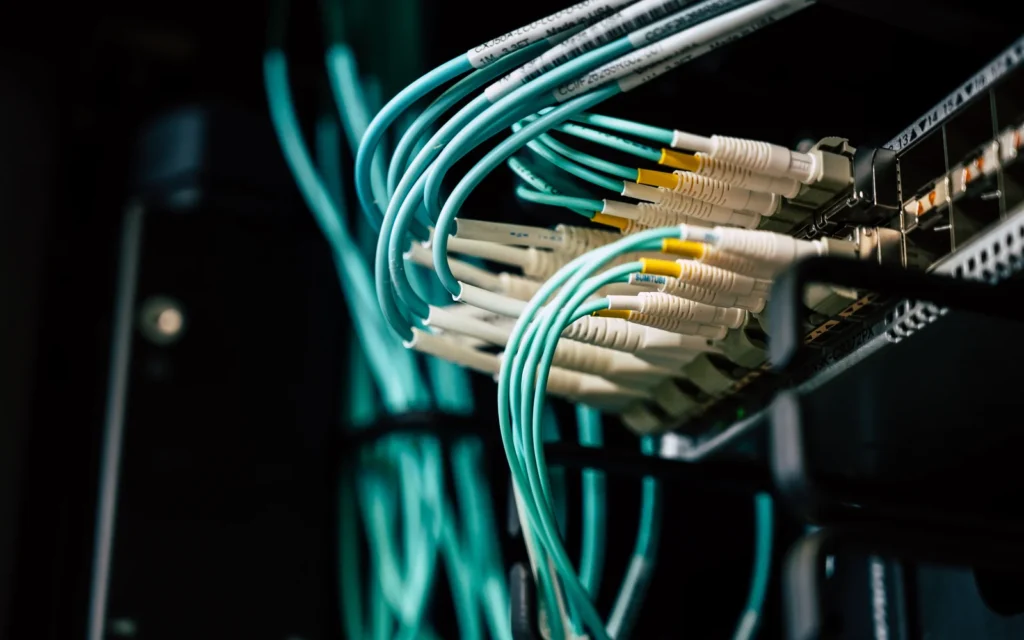
This guide designs an internal assistant preparing technical answers from authorised documents. Diagrams are original; the example is neither a completed project nor a benchmark. Authentic photographs illustrate infrastructure connections and document review, rather than product interfaces, client data or WebHat results.
Why compare responsibilities rather than names alone?
A tool suited to one stage does not automatically solve the others
The model produces an output, the application determines accessible data and the process establishes when an action may follow. Observability records what happened within configured boundaries. A visual editor helps build the flow but does not replace contracts between components. Draw these roles separately before selecting products.
In the design example, an employee requests a technical explanation of a service. The assistant searches only permitted documents, prepares a draft and submits it for internal review. It neither publishes the answer nor automatically contacts a customer. This boundary allows the proposal to be evaluated before introducing an external effect.
Within the map of types of artificial intelligence, these tools primarily concern application construction and operation. Choosing them alone establishes neither answer correctness nor special model training. The specification identifies which component owns each requirement and the evidence used to check it.
Four possible roles around the business application
The application retains the interface, users, access rules and business operations.
- LangChain · Components and agents
Model, tools and logic around the agent loop.
- LangGraph · State and orchestration
Nodes, transitions, checkpoints and review points.
- LangSmith · Observability and evaluation
Execution traces, test cases and version comparisons.
- Langflow · Visual construction
Components connected through ports within a configurable flow.
What role does LangChain play within an AI application?
Build around the model rather than replacing it
Current documentation describes LangChain through its configurable agent mechanism and components for models, tools and middleware. This layer can organise interaction with a model and supplied resources. It is not the model generating the answer and does not automatically provide a company's internal data.
For the technical assistant, define a tool reading authorised documents and a structure for the proposed answer. The application checks permissions before retrieval. The model does not receive a general connection to every file merely because a library offers an integration with that storage system.
The guide to AI agents and autonomy explains why access and initiative are separate decisions. An agent loop can fit situations where the next tool depends on the result. For a fixed sequence, keep deterministic steps where requirements already define them, without introducing probabilistic selection into every stage.
When does LangGraph become useful?
Describe the process through explicit state and transitions
LangGraph is a lower-level orchestration framework and runtime. It can combine deterministic hand-coded steps with model-driven ones. Nodes and transitions describe the process, while persistence and interruption mechanisms support its continuation. LangChain is not a requirement for every use of LangGraph.
In this example, routes might be sufficient documents, missing information or a proposal awaiting review. Operators should see the enquiry's state and what can unblock it. A retrieval error is not equivalent to information being absent from every document the company holds.
The connection with RAG and internal data in answers concerns the information source, not just the graph. Orchestration establishes when to retrieve, request clarification or stop. Document quality and answer correctness have their own checks, separate from whether nodes executed.
How do state, memory and context differ?
A checkpoint retains progress, not the freshness of every fact
LangGraph documentation distinguishes thread-associated checkpoints from stores holding information across threads. Backend selection matters: state held only in memory does not automatically survive a process restart. Configure and test persistence against the actual operating model.
State, source and execution trace are not the same thing
- Working state
The next step and retained intermediate result.
- Authorised document
Answer material with its version and access rights.
- Trace
Calls and results permitted for diagnostic recording.
For a technical answer, retain the process identifier and versions of documents used. If a document changes during review, continuation should detect the situation and apply the project's rule. A result saved yesterday does not become current merely because it loads correctly from a checkpoint.
The context window, memory and RAG address different problems. Persistent information is not automatically inserted in full into model context or permitted for every user. A thread identifier helps locate state; the application separately checks who may read or continue it.
A useful test begins an enquiry under one role, then changes permissions before continuation. The saved result should not subsequently expose documents that have become prohibited. Define whether the process stops, requests another review or recalculates its proposal from sources still accessible. This tests the application's rule rather than merely the technical ability to load old state from a database.
What does LangSmith add for observability?
An execution trace helps diagnosis without approving the outcome
LangSmith can collect and organise traces of application calls and steps, including those from other frameworks. These help investigate where an error appeared or which information was used. A trace shows a recorded execution; alone, it establishes neither answer truth nor operation authorisation.
For an incorrect technical answer, distinguish document retrieval, passage selection and conclusion wording. If the application used the wrong document, changing the prompt's tone does not address the cause. If it found the right document, investigate extraction and how the proposal used the available information.
For data protection in AI applications, define which inputs, outputs and metadata may reach the observability tool. Documentation provides hiding and filtering options. Configuring these is not replaced by assuming a technical log contains only non-sensitive information.
How does evaluation differ from merely recording execution?
A test case has a criterion, not just a saved answer
LangSmith separates evaluation on prepared datasets from monitoring operational interactions. For the proposed project, construct cases with the permitted document, required information and acceptance condition. Check that answers stay within the source's bounds and that the application handles missing documents or insufficient rights correctly.
Evaluate distinct questions, not just the final answer
- Retrieval
Was the appropriate document found within permitted sources?
- Fidelity
Does available information support the conclusion?
- Access
Did content remain within the user's permissions?
- Continuation
After a pause, are the version and operation checked again?
Evaluation can use code rules, human review or an evaluator model, depending on the criterion. An automated evaluator's score is not a truth certificate. For an access condition, the check should observe which document was actually exposed, not just the final answer's wording.
Compare variants on the same relevant cases and retain application, instruction and data versions. A good average does not close investigation of a critical case. This guide invents no product scores: it presents the protocol through which a project should produce verifiable outcomes.
What does Langflow do and where does the visual prototype end?
Connected components must become an operable service
Langflow allows components to be configured and connected through ports within a flow. Documentation describes saving, testing and using flows through execution interfaces. This construction approach can help a team examine the data path, but it is not the same product as the LangGraph runtime or LangSmith observability platform.
For the technical assistant, a visual prototype can show how the question and document reach the answer stage. Check which data type passes through each port and which configuration is saved. A result displayed in development does not yet demonstrate authentication, isolation or service behaviour for intended users.
Compare it with n8n AI automations according to the actual process rather than counting visual components. Application integration, assistant construction and agent operation can have different requirements. Justify the choice through responsibilities, interfaces and necessary tests, rather than the editor's appearance alone.

Which controls are not replaced by these tools?
State and interfaces are not sufficient authorisation boundaries
LangGraph can pause a process for external input and subsequently continue it. Documentation specifies that the interrupted node restarts, so code preceding that point can run again. Writes and communications need their own duplicate-prevention controls. Retained state alone does not confirm an external API's effect.
Langflow security documentation describes its editor as a development and code-execution environment. User and resource isolation must be implemented within infrastructure and application controls. Do not treat the editor as a secure public customer interface merely because flows appear within separate projects.
Choose the responsibility before the tool
- Model and tools
Interfaces and calling logic appropriate to the application.
- State and routes
Transitions, pauses and interruption recovery.
- Assessment
Test data, criteria and execution evidence.
- Visual construction
Components, ports and flow versions.
In the proposed example, document access is checked on retrieval and before using the result. Review retains the authorised person's identity and proposal version. If the answer or operation changes after approval, the control applies the reapproval rule. No execution trace substitutes for that permission.
How do we build the application without unnecessary dependencies?
Start with the minimum architecture covering the requirement
A simple fixed route might need only application logic, a model call and result validation. Where states, pauses or complex branches exist, assess the appropriate orchestration mechanism. Add observability and testing according to project needs without assuming everything must be purchased from the same suite.
Within custom software and application development, retain clear interfaces for the model, data and operations. This supports separately checking a change of model or orchestrator. An adapter should expose relevant results and errors rather than hiding every difference behind a generic message.
The specification includes startup, stopping, recovery and updating. Check what happens if the observability service becomes unavailable and which operations may continue under policy. Missing logs should not be confused with evidence that an operation never happened or should automatically be repeated.
Separate development configuration from the configuration serving users too. A test document should not enter commercial answers, and a writing tool used during checks should not remain implicitly available in the delivered version. For each environment, record sources, destinations and the person responsible for access. When moving a configuration, check these links explicitly rather than copying all secrets and permissions together with the graph. A demonstration working under an administrator's account should be retested with the actual user's role and the limited resources they may use.
How do we compare licensing and operating costs?
At review, the core LangChain, LangGraph and Langflow projects publish MIT licences in the official repositories consulted. This does not automatically grant identical terms for connected models, integrations or commercial services. Retain components and versions within the technical inventory together with their requirements.
LangSmith has platform options distinct from open-source libraries; the consulted documentation ties self-hosted and BYOC options to the Enterprise plan. Check hosting and retention choices against the project contract. Do not infer that the entire platform is free from the licence of a library used within the application.
Budget includes model calls, storage, observability, evaluations and maintenance. Measure cost per defined operation and retain failed attempts too. A workflow with fewer calls might require different review time; compare accepted outcomes rather than merely the price of one model request.
For estimation, separately inventory ordinary calls, clarifications and retries. Establish what checkpoints retain, how long traces remain and which data is excluded before collection. Then test behaviour when approved limits are reached: the request might wait, stop or use the specified alternative path. That decision belongs to requirements and the interface rather than being accidentally left to the provider. Cost reporting should explain why the same request involved several stages without concealing calls that produced no accepted answer.
How do we select the appropriate combination for a business?
First specify what the application should know and do, which states it retains, who approves and which evidence is required. Then compare the minimum implementation with options adding orchestration, a visual editor or an evaluation platform. Every selected component should correspond to a requirement, not merely a technical preference.
A deliverable project contains more than a prototype
- Requirement
Purpose, users and accepted outcome.
- Architecture
Responsibilities and strictly needed components.
- Control
Permissions, versions and boundaries for effects.
- Evaluation
Representative cases and reproducible comparisons.
- Operations
Logging, retention, maintenance and controlled fallback.
A business automation project with AI integration is delivered with its workflow, permissions and checks explained. For the technical assistant, success means an auditable answer from permitted sources and a controllable review process. The framework's name is an implementation choice rather than the commercial outcome's definition.
After selection, retain a representative test set and an updating path. Every new component has an administration cost and clear responsibility. Keep the architecture explainable to the team: where information resides, how decisions are made and what must be checked before a result has an effect.
Frequently asked questions about the four AI tools
Is LangChain a language model?
It is a framework containing components and mechanisms for applications and agents. The language model is a connected component with its own capabilities and usage conditions. Configuring LangChain does not automatically mean training a new model for the business.
Must we use LangChain to use LangGraph?
LangGraph can be used without LangChain. They can collaborate, and LangChain agents use LangGraph mechanisms in the documented architecture. The choice depends on the required control level and project components.
Can LangSmith be used with other frameworks?
Documentation describes integration with applications built on other stacks too. Select which calls and data are traced and how results are evaluated. Enabling observability does not automatically grant permission to send every piece of client information into logs.
Is a Langflow flow already a production-ready application?
The flow is part of the application. Authentication, isolation, execution configuration, maintenance and process tests remain separate responsibilities. A visual prototype supports checking the mechanism, while delivery also includes operating conditions for real users.
Does a checkpoint prevent every repeated action?
It retains state according to the configured mechanism. Some continuations re-execute code, and an external effect can have an unknown outcome after interruption. Operations with effects need stable identifiers, target verification and their own duplicate-prevention controls.
How do we avoid an excessively complicated stack?
Connect every component to a measurable requirement: calls, state, review, diagnosis or visual construction. Compare it with a simpler implementation on the same tests. Retain only components whose administration and cost are justified within the business process.