
YouTube is beginning to treat search less as a list of results and more as a conversation. Through Ask YouTube, the user can formulate a complex question and continue with follow-up questions, while the platform builds an interactive answer based on relevant videos from across the catalog, including long-form videos and Shorts.
At launch, the feature is available through YouTube's experiments area to YouTube Premium members over the age of 18 in the United States, and the company says it intends to expand it more broadly. It is not currently a confirmed feature for every account in Romania. But the direction is worth watching now: if people search through complete questions, video content needs to be capable of providing complete answers rather than merely attracting a click with a spectacular title.
For businesses, the change does not mean that every video automatically becomes “optimized for AI.” It means that a video has a better chance of being easy to understand when it explains the subject clearly, shows evidence, speaks the audience's language and is organized so that either a person or a system can quickly find the relevant section.
What Ask YouTube does
A user can begin with a specific need rather than necessarily using a set of short keywords. YouTube's example is a question about teaching a child to ride a bicycle or reviews of games suitable before bedtime. After the first answer, the user can ask further questions to refine the result.
Ask YouTube analyzes long-form videos and Shorts to compile relevant material into a structured answer. The feature is not presented as a summary of the whole of YouTube or a guarantee that every video will be included. It is a discovery experience: the platform tries to connect the user's intent with videos that appear useful for the question.
This is where it differs from a conventional search. Instead of competing only for a phrase such as “how to choose a bicycle,” a video may form part of a richer question journey: “what size is suitable for a child who is a beginner?”, “which mistakes should be avoided?”, “what are the differences between two options?” or “how do I check that the product is compatible?”.
Current availability: what we know and what we do not
According to the official May 2026 announcement, Ask YouTube is available to Premium users aged at least 18 in the United States through youtube.com/new. YouTube says it is considering a broader release, but the announcement does not give a date for Romania or every Premium market.
It is important not to confuse the availability of YouTube Premium with access to Ask YouTube. Premium is available in Romania, but this does not prove that the conversational search experiment has been activated here. For content planning, the practical conclusion is simple: prepare videos for real questions without investing budgets solely on the assumption that an experimental feature is already active locally.
What changes for video promotion
In a conversational experience, a valuable video is not merely “interesting.” It needs to support a useful proposition: explain a process, compare options, show a product in use or answer an objection that arises before purchase. This shifts attention from simply accumulating views towards clarity of information.
For example, a company selling water filtration systems can produce a generic video about “the best filter.” A more substantial video answers questions the audience genuinely has: which impurities a particular model can filter, what type of home it suits, what maintenance it requires, what it does not solve and how it compares with an alternative. Not every video needs to be a long lesson. The promise, explanation and demonstration simply need to meet.
Spoken words, subtitles and video structure
YouTube has not published a list of “ranking factors for Ask YouTube.” It would be incorrect to claim that a particular number of chapters or repetition of a phrase guarantees inclusion in an AI answer. We can, however, reasonably infer from the way the feature compiles video materials that a video needs to be intelligible at the content level rather than merely attractive visually.
The following elements therefore become even more useful:
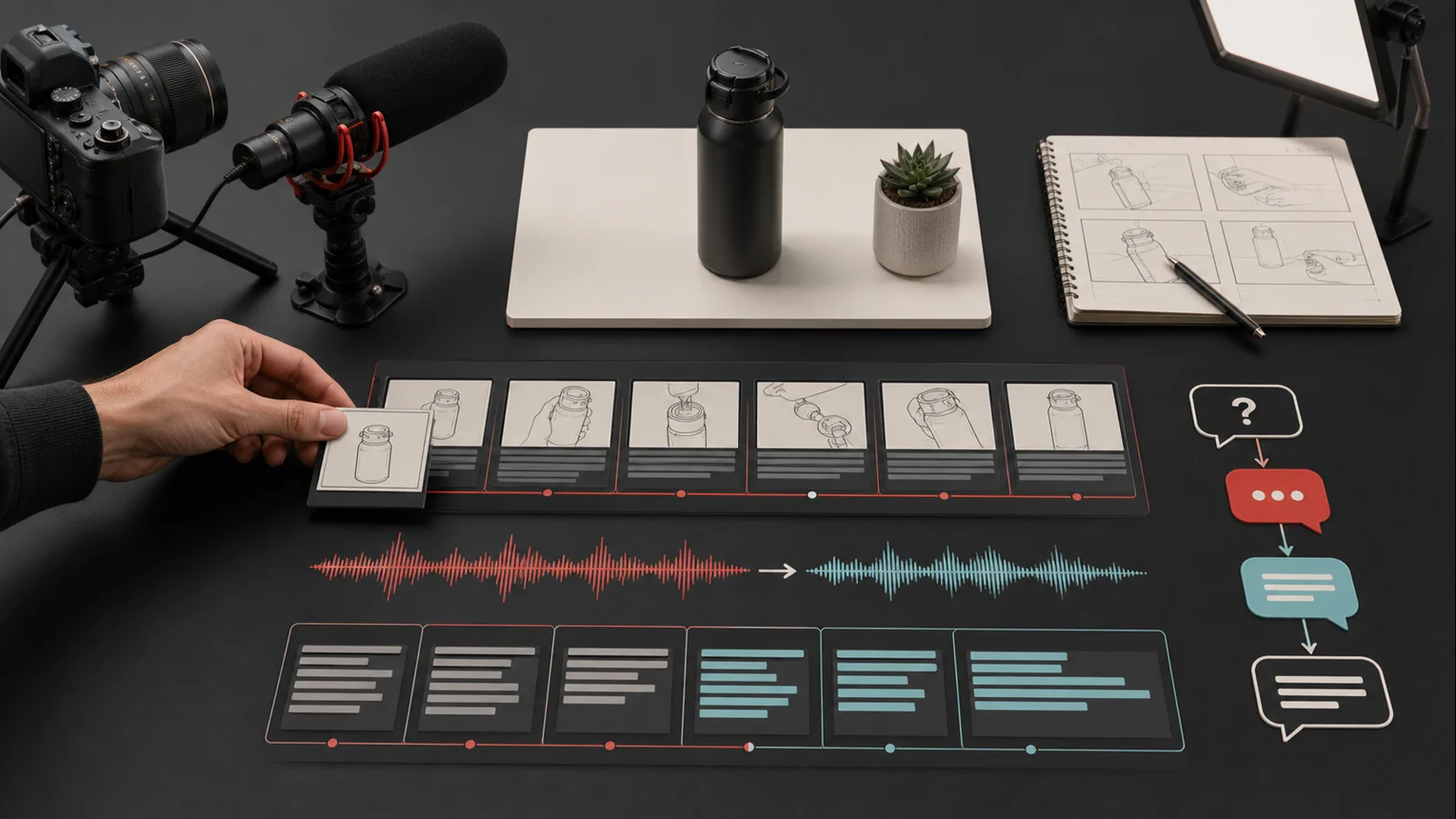
- A clearly spoken explanation. State which problem you solve and use the terms the audience would use in a question. Avoid long introductions in which the subject appears only after a minute.
- Accurate subtitles. They help people watching without sound and reduce ambiguity in product names, technical terms or figures. Automatic subtitles are worth reviewing before publication.
- An honest title and description. The title should promise exactly what the material explains. In the description, provide context, resources, specifications and useful links without artificial keyword lists.
- Chapters with useful names. A chapter named “How to install it,” “When it is unsuitable” or “Maintenance costs” is clearer than “Part two.” It helps the user select the information they need.
- A real visual demonstration. When you show the product, process, interface or result, the explanation becomes harder to misinterpret and easier to remember.
Long-form video and Short: two answers for different intents
Ask YouTube includes both formats, which is a good reason not to build a channel from only one type of video. A long-form video can answer a multi-stage problem completely, show the limits of a solution and include comparisons or case studies. A Short can answer a narrow question quickly, correct a common misunderstanding or show one visual step that convinces the user to continue researching.
A sound approach is to build a family of answers rather than mechanically cutting the same video into dozens of pieces. Begin with a principal guide, identify the secondary questions and create Shorts with independent value: each needs a beginning, an answer and a demonstration. Then connect them to the complete material, the website and the appropriate commercial step.
A simple model for a video script
- State the audience's question. Do not begin with the company slogan. Begin with the problem the person is trying to solve.
- Give the indicative answer quickly. In the opening seconds, say who the solution suits or what the main idea is.
- Show the evidence. Present the product, process, interface, material, before-and-after situation or a real example. Do not rely on claims alone.
- Explain the limits. A credible video also says when a solution is unsuitable, which conditions apply or what needs to be checked first.
- Organize the key moments. Use chapters when the subject has clear steps and name them according to the question each section answers.
- Review the transcript. Correct product names, terms and any phrase that automatic subtitling misunderstood.
- End with an appropriate step. It may be a guide, comparison, form, demonstration or conversation with the team. The call to action should relate to what the user learned.
Why real demonstrations become more valuable
An AI answer can group videos, but cannot create the real experience a company shows. A demonstration in which the product is visible, a specialist explains a decision, a customer presents their process or a team tests a specific situation provides details not found on a generic page.
This is where video can complement conventional SEO. The website retains the commercial information, specifications and conversion. Video shows the context, rhythm, materials, interface, people and questions that arise in practice. Within a social media promotion strategy, the same film can become a YouTube guide, sequences for Reels or TikTok and a resource embedded in a relevant website page.
Originality matters especially here. In-house filming, comparisons made by the team, demonstrations with the real product and answers drawn from customer conversations are harder to replace than a compilation of stock images and general promises.
What is worth monitoring in measurement
YouTube has not announced a separate report showing appearances in Ask YouTube. A KPI should not therefore be invented for a feature that does not yet provide detailed public data. Measure what can be tracked accurately: search queries in YouTube Studio, retention around chapters, clicks from the description, quotation requests, traffic to relevant pages and the types of questions received in comments or sales conversations.
If a particular video repeatedly attracts the same question, do not treat it only as a comment. It can become the next Short, a new chapter, a website FAQ or an explanatory page. This is how to build a video catalog that progressively answers audience intent rather than merely a collection of independent posts.
Frequently asked questions
Is Ask YouTube already available in Romania?
There is no public confirmation for every account in Romania. In the May 2026 announcement, YouTube described access for Premium members aged at least 18 in the United States and said that it planned a broader expansion.
Do I need to make only long-form videos to appear in AI search?
No. Ask YouTube can use both long-form videos and Shorts. The format should be selected according to the depth of the answer: a complex guide needs space, while a very precise question can be explained usefully in a Short.
Do subtitles and chapters guarantee inclusion in Ask YouTube?
There is no such guarantee. They do, however, help make the video clearer to users and easier to browse. The real benefit comes from an accurate, well-organized and demonstrated answer.
Is it enough to repeat keywords in the video?
No. Artificial repetition produces tiring content and does not replace an explanation. Use the customer's natural vocabulary, answer questions and show the information supporting the answer.
Sources
- YouTube Blog – the Ask YouTube announcement, complex and follow-up questions, use of long-form videos and Shorts, and initial availability.
- YouTube Help – information about YouTube Premium availability in Romania, which is distinct from the Ask YouTube experiment.