
On 16 July 2026, Google announced an important expansion for AI Mode in Search: users can connect services such as Instacart, Canva and YouTube Music to carry out actions directly from the search experience. This is a significant direction because Search is no longer presented only as a place to find a link, but as a space in which part of a process can begin and continue.
The launch begins in the United States. There is no confirmed date for Romania, and this nuance must be preserved. Nevertheless, the change is worth monitoring for every business that depends on organic traffic, conversions, content, advertising or digital experiences. If Google Search can move a user closer to action without an immediate website visit, the website's role must be considered more carefully.
What Google announced
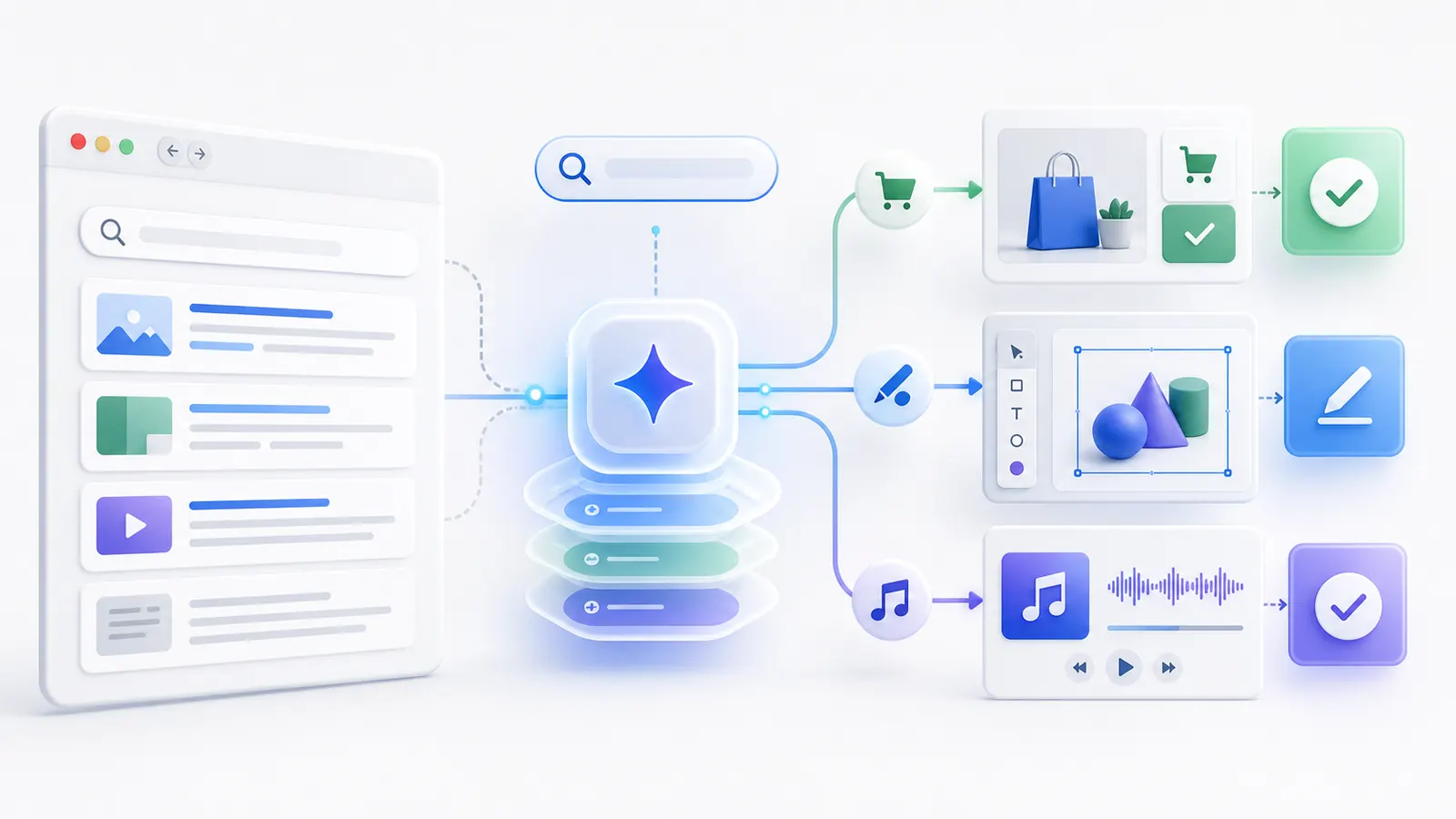
Google says users can connect favourite applications and services directly in AI Mode. The examples are practical: someone planning a barbecue can ask for help with a shopping list and, if Instacart is connected, the ingredients can be added to the Instacart basket. For a visual project, the user can request template options in Canva. For music, AI Mode can create a playlist and save it in YouTube Music.
These examples show a new interaction model: the question does not end with the answer. Search attempts to connect intent to an action. This is more convenient for the user. For businesses, however, it raises new questions about visibility, conversion attribution, control of the experience and the website's place in the buying journey.
Why this is a major change for Search
In the traditional model, Google sends the user to external pages. The website receives the visit, explains the offer, presents options and tries to move the user towards a conversion. In the AI Mode model with connected applications, some steps may take place before the user reaches a business website or even without reaching it in the same session.
This does not mean websites become unnecessary. It means their role is changing. The website must be clearer, better structured and more useful as a source of verifiable information. If AI systems need to understand services, products, prices, availability, differences and commercial conditions, the information must be clean, current and easy to interpret.
For many businesses, the issue will not be only their position in results, but also how effectively real intent can be extracted from their pages. A confusing page with incomplete information, vague promises or weak technical structures may lose relevance in an ecosystem where AI assistants try to shorten the user's journey.
What it means for SEO
SEO is not disappearing, but it is becoming more dependent on structure, clarity and authority. If a user asks “help me choose”, “create this for me”, “add it to the basket” or “find a suitable option”, Google may try to turn the search into a decision flow. This raises the minimum standard for content: a title and a few general paragraphs are no longer enough.
Commercial pages must explain directly what the service includes, whom it suits, which options exist, what the limitations are, which costs may arise separately and what the next step is. Articles must develop the subject rather than merely repeat keywords. Structured data, internal links, relevant images, speed and language consistency become practical signals, not just technical details.
For Web Hat Solutions, this direction confirms the importance of optimization for search and for AI-assisted interpretation. The page about AI and LLM optimization addresses precisely this area: how to make content easier for search engines, AI systems and real users to understand.
What it means for online stores and applications
The Instacart example is relevant to e-commerce: the user does not necessarily search for an isolated product, but may request a complete outcome, such as ingredients for a meal or a list for an event. In such contexts, the catalogue must be well organized. Products, categories, descriptions, prices, availability and attributes must be clear.
The direction is similar for applications. If AI assistants can call external services, companies will need better-connected systems: APIs, data flows, permissions, action histories and checks. A custom application can become more valuable when its data is prepared for integration rather than trapped in tables, emails or platforms that do not communicate with one another.
Businesses considering custom applications with AI integration should therefore begin with simple questions: which actions are repeated, which data is required, what can be automated, what must be confirmed manually and which system must retain final control.
What is not confirmed for Romania
Google says the rollout begins in the United States. No official timetable has been announced for Romania. It would therefore be incorrect to treat this feature as locally available or as an immediate change for every market. It is correct, however, to monitor it as a directional signal.
Such launches generally appear first in large markets, with specific partners and account, language or regional restrictions. Even if local availability is delayed, user behaviour and expectations can still change. People become accustomed to interfaces that answer and act, rather than merely displaying links.
What businesses should do now
The first step is not to rebuild the entire website after every AI announcement. The first step is an audit of content and structure. Important pages must answer user questions completely. Commercial information must be explicit. Forms, buttons, contact details and next steps must be clear.
The second step is to organize the data. Online stores need clean products and categories. Service companies need dedicated pages for every important offer. Internal applications need structured data, not information scattered across emails and files. Without orderly data, AI integration becomes fragile.
The third step is measurement. If Search gradually moves towards actions, raw traffic may become harder to interpret. Businesses must track leads, conversions, sources, frequently asked questions, AI-assisted pages and contact quality, not only visit numbers.
Practical checklist for businesses
- Check whether services and products are described clearly enough for an AI system, not only for a hurried visitor.
- Ensure clean data for prices, availability, locations, opening hours, services and ordering steps.
- Track conversions and lead quality, not only raw traffic, because some actions may begin directly in AI interfaces.
- Build pages that explain the differences between options, rather than simple lists of services.
What to remember in practice
AI Mode integration with Instacart, Canva and YouTube Music shows a clear direction: Google wants Search to become more operational. For the user, this may mean fewer steps. For businesses, it means a greater need for clear content, clean data, well-explained services and systems prepared for integration.
The website remains important, but it can no longer be merely an online brochure. It must become a structured source of information, a point of trust and a technical foundation for campaigns, SEO, applications and automation.