The Wall Street Journal reports that several major editors, publishers and platforms are considering limiting Google's access to content amid declining organic traffic and the expansion of AI answers in Search. Google, by contrast, maintains that AI Search continues to send billions of clicks to the web.
The news is relevant to every website that depends on organic visibility. This is not only about large publishers. It concerns a change in Search behaviour: users receive increasingly more answers directly in Google, and a click through to the website is no longer guaranteed even when the page is used as a source.
What is happening between publishers and Google
According to the Wall Street Journal, major publications and platforms are discussing whether they should limit Google crawlers' access to their content. The stated reason is simple: if Google uses content to build AI answers and users no longer click through to the source, publishers' economic model becomes more fragile.
At the same time, blocking Google is a risky decision. For many publications, Google remains one of the most important sources of traffic. Closing off access may protect content from certain AI uses, but it may reduce Search visibility even further. The discussion is therefore not merely technical, but commercial and strategic.
Google's position
Google rejects the idea that AI Search is destroying its relationship with the web. The company says AI Overviews and AI Mode are designed to help users discover relevant websites and that Search continues to send billions of clicks to the web. In a recent post, Google discussed new opportunities, controls and insights for website owners.
This position must be read realistically. Google may continue to send very large volumes of traffic overall, while the distribution of that traffic changes. Some websites may gain and others may lose. Some types of query may produce fewer clicks, while others may bring better-qualified visitors. Aggregate data does not automatically reveal what is happening to each website.
Why publishers are affected differently
Publishers produce many informational answers: news, explanations, guides, analyses, definitions, timelines and comparisons. This is precisely the kind of content that an AI answer can summarize quickly. If users receive enough context directly in Google, their motivation to open the article may decrease.
However, not every traffic decline can be attributed to AI Overviews. Publisher traffic is also affected by algorithmic changes, seasonality, competition, social media, consumption behaviour, paywalls, mobile applications, Google Discover and changes in audience interest. Diagnosis must therefore be based on data, not assumptions.
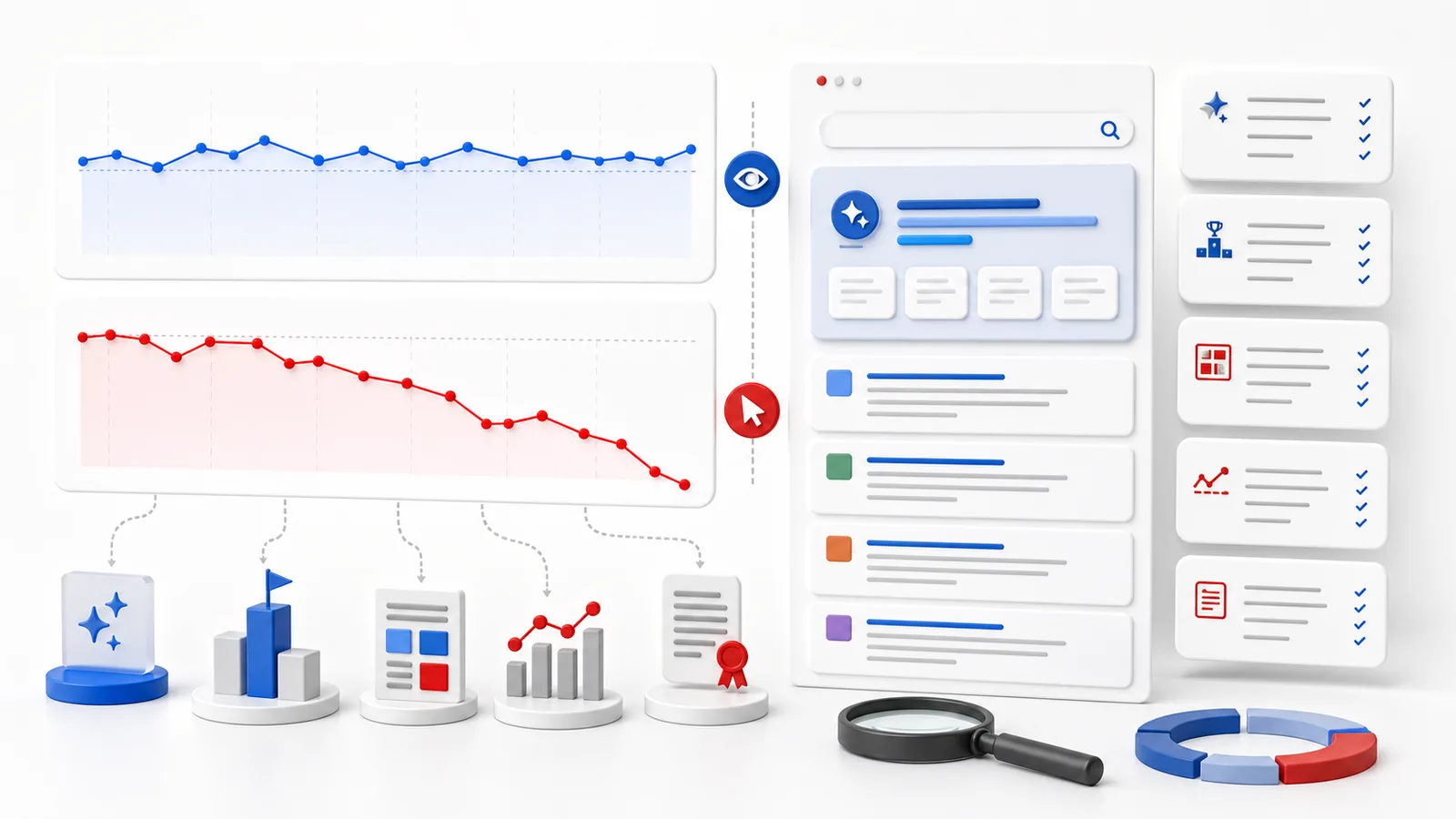
The stable impressions, declining clicks pattern
One signal worth monitoring is the combination of stable or rising impressions and declining clicks. In Search Console, this may indicate a CTR issue. Sometimes the cause is a weak title, a less attractive snippet or a lower position. At other times, the cause may be a change to the results page: an AI Overview, People Also Ask, video results, carousels, a local pack or other elements that reduce the traditional organic click.
In the context of AI Search, this pattern becomes very important. If the page continues to appear but the user no longer visits it, it is necessary to check what changed in the SERP for those queries. Without this check, we risk blaming AI for a problem that may have several causes.
How to verify the impact on a website
The first step is to segment the data in Search Console. The main queries, pages losing clicks, countries, devices and trends across comparable periods must be analysed. A desktop decline may have a different explanation from a mobile decline. A decline affecting informational articles may have a different cause from one affecting commercial pages.
The second step is to inspect the results manually for important queries. If an AI Overview appears, note whether the website is cited, whether the link is visible, which other sources appear and whether the traditional organic result has moved down. If there is no AI Overview, look for other explanations: competition, outdated content, title changes, technical problems or shifts in intent.
Blocking Google: solution or risk?
For most businesses, blocking Google is not a realistic solution. Commercial websites need indexing, visibility and qualified traffic. Large publishers may negotiate, test or build alternative monetization models. A local business, online store or service company generally cannot afford to lose access to Google Search.
There are, however, technical controls that can be used carefully: robots.txt, noindex, nosnippet, max-snippet, data-nosnippet or controls governing access for particular crawlers. They should not be applied impulsively. An incorrect rule can remove pages from results or drastically reduce visibility.
What businesses can do instead of blocking
For businesses, the practical response is adaptation, not blocking. Content must be more specific, more original and harder to replace with a generic summary. A good page does not merely provide definitions; it provides context, examples, prices, processes, comparisons, original photography, local data, real experience and concrete steps.
Conversions, not only clicks, must also be monitored. If AI Search reduces some informational traffic but brings fewer and better-qualified visitors, the strategy must be adjusted differently than when traffic and leads decline together. Search Console data must be combined with Analytics, forms, telephone calls, CRM data and campaign results.
Impact on SEO and promotion
SEO can no longer be treated as a simple increase in positions. Visibility must be monitored across several types of results: traditional organic, AI Overviews, AI Mode, Discover, video, images, social media and external profiles. At the same time, paid promotion, social media and editorial content must work together.
In Web Hat Solutions projects, this direction is directly connected to SEO, AI and LLM optimization and online promotion. The objective is not to follow each Google change in isolation, but to build digital presences that can be found, cited, compared and converted into real enquiries.
What to monitor in Search Console
It is worth monitoring pages with stable impressions and declining clicks, queries with reduced CTR, pages losing positions, mobile versus desktop differences, appearances in Generative AI reports, Discover performance and changes in brand search. Not every decline requires the same intervention.
If CTR falls, better titles and meta descriptions may be needed. If impressions fall, the problem may concern content, indexing or relevance. If AI impressions appear without clicks, assess whether the page is being used only as an informational source or whether it has a clear offer worth visiting.
Practical checklist for businesses
- Do not block Google as a general reaction; first check which pages are losing clicks and for which queries.
- Look for the “stable impressions, declining clicks” pattern in Search Console and compare desktop with mobile.
- Inspect the SERP manually for important queries: an AI Overview, video, local pack, shopping results or other elements may change CTR.
- Strengthen affected pages with examples, evidence, original photographs, comparisons and answers worth visiting, not merely citing.
What to remember in practice
The fact that publishers are discussing blocking Google shows how tense the relationship between content and AI Search has become. Google needs the web to provide useful answers, while publishers need traffic to finance content. If this balance breaks, negotiations, technical controls and new monetization models emerge.
For commercial websites, the lesson is more pragmatic: do not block impulsively; measure instead. The “stable impressions, declining clicks” pattern is real and must be monitored on each website. AI Overviews may be one cause, but not the only one. Good decisions come from diagnosing pages, queries and conversions, not from broad reactions to a market change.