
A useful voice agent is not a synthetic voice placed on top of a telephone menu. The difference appears when a person can speak naturally, interrupt an answer, correct a request and continue the conversation while the system checks availability, consults authorised data and prepares the next step without losing context.
GPT-Live-1 is OpenAI's model for this kind of interaction. It can listen and speak at the same time, while tasks that require reasoning, tools or access to company systems can be delegated to a separate backend agent. For a business, the important development is not simply that "AI can talk". Voice can become a natural interface for a custom application with AI integration.
In brief: GPT-Live-1 manages the conversation, the backend verifies and executes, and the company's application retains control over permissions, confirmations, data and the evidence of each operation. If these responsibilities are mixed together, a fluent demonstration can turn into an unpredictable business process.
Why GPT-Live-1 is more than a chatbot that speaks
Many existing voice systems follow a rigid sequence: listen, convert speech to text, wait for an answer, turn that answer back into speech and only then resume listening. The pauses are noticeable, interruptions are difficult to handle, and any departure from the script may force the caller to repeat information.
GPT-Live-1 supports a full-duplex conversation, which means that both audio streams can be active simultaneously. The caller can add a detail while the agent is speaking, and the agent can stop its response and continue from the corrected context. A slower task can run in the backend at the same time. For example, a caller can request an appointment, correct the preferred day while the calendar is being checked and receive available options without restarting the dialogue.
| Voice solution | How it works | When it makes sense |
|---|---|---|
| Traditional IVR menu | Fixed options selected with keypad input or short commands | Simple routing and entirely predictable processes |
| Speech-to-text-to-speech pipeline | Each stage can be inspected and replaced separately | When control over transcription and intermediate text is essential |
| Realtime API | One model handles voice, reasoning and tools | Fast conversations with a compact architecture |
| GPT-Live-1 | The voice model maintains the conversation while a separate backend completes tasks | Natural dialogue that continues while the application checks data or executes work |
The choice should not be based on how impressive a short demonstration sounds. An IVR is still better for an operation with exactly two choices and no need for interpretation. A speech-to-text-to-speech pipeline may be preferable when an organisation must control each individual stage. GPT-Live-1 becomes valuable when the conversation is variable and the company already has data and services that can respond within controlled boundaries.
A two-plane architecture: conversation and work
OpenAI's documentation separates the system into two components. The first is the live model, which listens, speaks and decides when it needs assistance. The second is the backend, which can analyse a request, call tools and return a verified result. The two components can continue working in parallel.
- The audio channel carries the conversation from a browser, mobile application or telephone network.
- GPT-Live-1 manages pacing, interruptions, clarification and the wording of the response.
- Delegation sends only the task that needs data, reasoning or tools to the backend.
- Company services check the calendar, CRM, orders, documentation or other permitted sources.
- The control layer validates identity, permissions, arguments and required confirmations.
- The verified result returns to the conversation and the agent explains it naturally.
This model allows a business to retain an existing text-based workflow. A company that already has a secure order-status function or an appointment automation does not need to move all of that logic into the voice model. Voice becomes the interface, not the database and not the authorisation mechanism.
Two delegation modes and two levels of control
GPT-Live offers two principal ways to handle backend work. With Responses delegation, the voice model sends the task to a configured Responses model together with the context it needs. OpenAI manages the connection between the two components, while the application still executes custom functions.
With client delegation, the company's application receives the delegated request, builds the context, selects the appropriate agent or service and decides which result may return to the conversation. It requires more engineering, but it makes it possible to filter data, combine several systems, use different models and stop an unsuitable result before it is spoken.
| Criterion | Responses delegation | Client delegation |
|---|---|---|
| Implementation | Fewer components managed by the company | Routing and state managed by the application |
| Control over context | Context prepared by the GPT-Live workflow | The application chooses exactly which data is sent |
| Result validation | Suitable when a result can return directly | Suitable when a result must be checked, redacted or combined |
| Tools and models | Capabilities compatible with the Responses configuration | Proprietary services, different providers and custom rules |
| Operational complexity | Lower | Higher, but with more precise boundaries |
The first mode may be sufficient for a simple appointment workflow. For financial information, sensitive data, several internal systems or commercial rules that vary by role, client-controlled delegation is often easier to audit.
What a voice agent can automate in a business
Appointments and rescheduling
The agent can identify the requested service, location, preferred time and contact details, then check the calendar through a narrowly scoped function. A booking should not be created until the caller hears and explicitly confirms the date, time and location. An online appointment application can retain the schedule and business rules, while GPT-Live-1 adds a voice interaction for customers who prefer to speak.
Lead qualification
Instead of mechanically asking ten questions, the agent can adapt its questions to the conversation. It can identify the objective, urgency, indicative budget and missing information, then send a structured summary to the CRM. It must not promise a price, deadline or availability that the backend has not confirmed.
Order and service information
After an appropriate identity check, the agent can consult an order status, approved service conditions or a curated knowledge base. When an exception appears, the conversation history and tool results can be transferred to an employee so the customer does not need to retell the entire story.
Reception and intelligent routing
A call can be routed by intent, language, customer or type of issue. The agent may resolve repetitive requests and transfer the call when it encounters a complaint, a sensitive situation or a request outside its competence. The purpose is not to prevent access to people, but to reserve their time for the cases where human judgment matters.
Internal assistance
A field technician can ask for a piece of equipment's procedure, the status of an intervention or the next item in a checklist. An internal application can display the information at the same time and record progress, with explicit rules defining what may be updated by voice.
These scenarios become a real product only when they connect to the company's actual systems. In a custom application with AI integration, the voice model is one component alongside the interface, user accounts, APIs, logging and administration. For processes that pass through a CRM, calendar, notifications and a team, business automation with AI integration keeps repeatable steps in code and uses the model only where interpretation adds value.
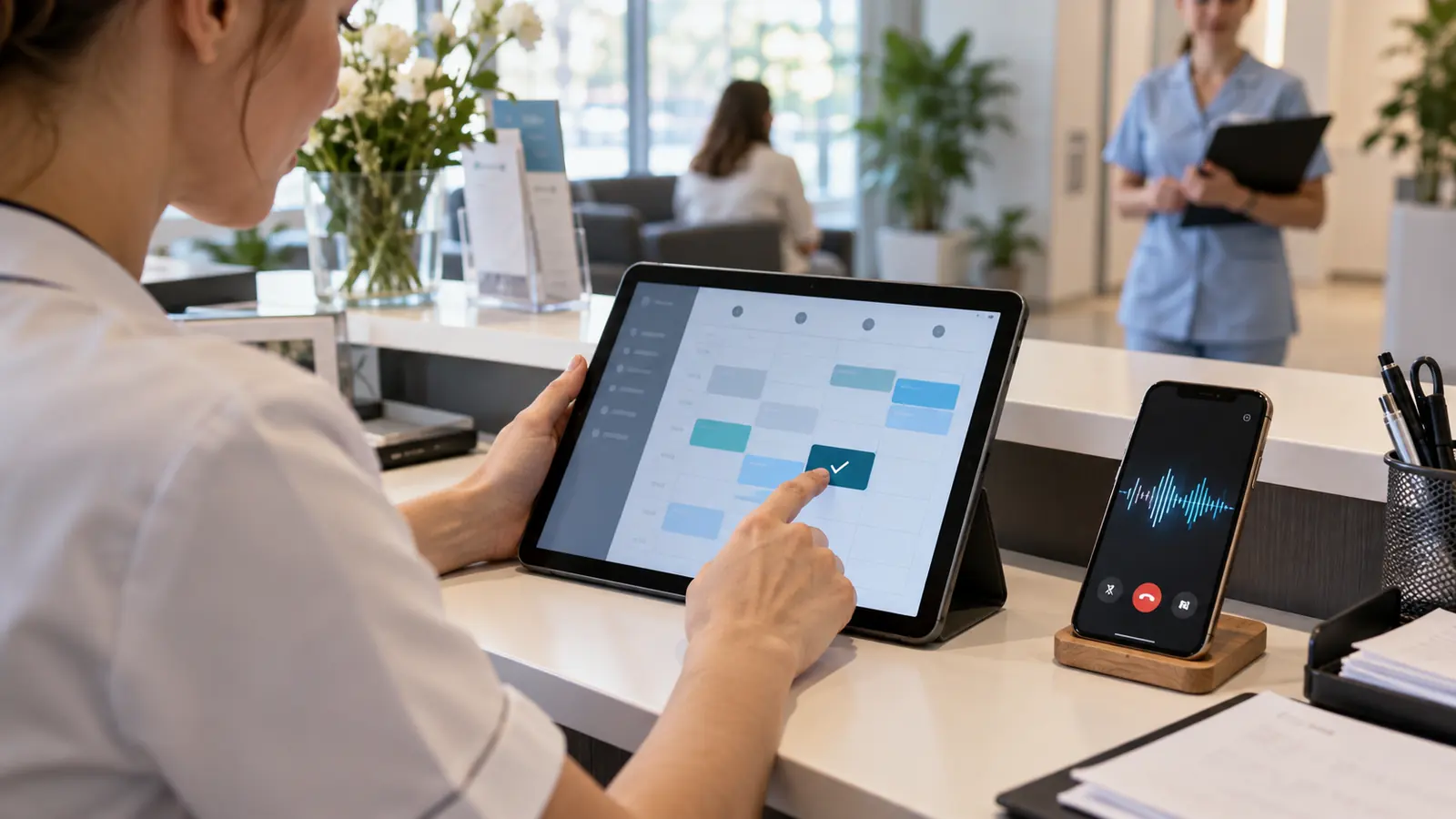
A complete example: booking an appointment by phone
Suppose a customer calls a clinic and asks for an appointment on Tuesday afternoon. A mature workflow does not give the model broad calendar access, and it does not treat the first stated preference as final consent.
- The agent briefly explains that it is an automated voice assistant and asks which service the caller needs.
- It collects the preferred interval and minimum required information without requesting data that is unnecessary for the booking.
- It delegates the availability check to the backend; the conversation can continue with a relevant clarification.
- The availability function reads only permitted slots and returns suitable options.
- The agent presents a small number of options rather than reading a long list.
- The customer selects a time and can correct that choice before confirmation.
- The application repeats the date, time, service and location, then asks for explicit confirmation.
- An idempotent function creates the reservation exactly once and returns an identifier.
- The agent confirms only after the successful record is returned and offers a written confirmation.
- If the result is uncertain, the call is transferred; the system does not pretend that a reservation exists.
One technical detail is critical: when the caller interrupts the agent's speech, work already delegated to the backend is not cancelled automatically. The application must decide whether the corrected request invalidates the task in progress. Without this rule, a customer may say, "No, Wednesday," while the old Tuesday reservation continues to be created.
Telephone, browser or mobile application
GPT-Live-1 can be connected through several routes, and the choice affects latency, security and technical responsibility.
- WebRTC is suitable for conversations that begin in a browser. Audio travels over media streams and application events over a data channel.
- WebSocket is suitable when a server receives and forwards the audio, for example in an existing integration or a system that needs to process the stream.
- Direct SIP allows a telephony provider to send audio to OpenAI while the company's backend manages webhooks, call acceptance and business logic.
- An application-managed audio bridge offers maximum control over both connections, but adds responsibility for playback, event translation and the complete call lifecycle.
The documentation includes integration paths for Twilio, Telnyx, LiveKit and Daily/Pipecat. That does not remove the need for product design: the telephone number, routing, opening hours, transfer, fallback messages and incidents all need to be treated as core parts of the service rather than secondary settings.
A natural voice must not have unlimited authority
A fluent voice can inspire more trust than text on a screen. That is precisely why the system should be honest about its automated nature and cautious about its claims. In healthcare, legal, financial and emergency contexts, or for decisions with significant effects, the agent should not improvise professional recommendations or create the impression that it is an authorised person.
Control should be divided inside the application:
- the voice model may explain, clarify and present confirmed results;
- the backend may consult sources and prepare actions within defined limits;
- code validates arguments, identity, role and current state;
- the user confirms operations that have consequences;
- an employee handles sensitive, ambiguous or disputed cases.
For telephony webhooks, OpenAI recommends signature verification and delivery deduplication. SIP metadata should be treated as unverified information, not proof of identity. Similarly, a retry after a network error should first check whether the booking, order or message has already been created.
Data, recordings and residency
Voice conversations may contain names, telephone numbers, addresses, preferences and confidential information. Design should begin with data minimisation: what is necessary, where it travels, how long it is retained and who can access it.
According to the OpenAI documentation reviewed on the publication date, GPT-Live session storage is disabled by default. If a project permits storage and uses store: true, the recording of a completed session may be retained for 30 days. The GPT-Live endpoint is eligible for Zero Data Retention and offers United States or European data residency options. These conditions do not automatically extend to the delegated model, tools or telephony provider; each component must be assessed separately.
For a Romanian or European business, a practical assessment should cover notice to the user, the purpose and legal basis of processing, access to recordings, retention, supplier contracts and the deletion or objection procedure. A technical configuration does not replace legal analysis for the particular field and use case.
How much does a GPT-Live-1 conversation cost?
The model page lists a price of USD 0.05 per minute for the voice session, billed by the second. Active time includes user speech, agent speech, silence and time spent waiting for backend work. A muted session that remains open continues to consume time. The backend model and tools are billed separately, and telephony has its own charges.
As an indicative example, 1,000 calls with an average duration of three minutes total 3,000 minutes, or approximately USD 150 for the GPT-Live-1 layer alone. Delegated models, searches or other tools, application infrastructure and the telephony provider must be added. The real calculation should use API session duration, not only the time during which the speaker produced sound.
| Metric | Why it matters |
|---|---|
| Cost per completed call | Connects every component to an outcome rather than to minutes alone |
| Cost per valid appointment | Separates useful conversations from abandoned attempts |
| Silence duration | Shows whether the caller waits too long for backend work |
| Transfers to an operator | Reveals where automation lacks enough data or authority |
| Corrections after confirmation | Signals context or validation errors |
Reducing cost does not mean making the agent speak too quickly. It means closing sessions correctly, using concise responses and fast tools, avoiding duplicate calls and selecting a backend model proportionate to the task.
How to test a voice agent that must work in Romanian
A trial with two clearly spoken questions in a quiet room says very little about production. Romanian should be tested with personal names, towns, addresses, times, numbers expressed in different ways, regional accents, poor connections and real background noise. If documentation does not explicitly guarantee a certain level for a language, field or vocabulary, performance must be demonstrated on the company's own conversations.
OpenAI recommends measuring the final outcome rather than the impression created by the voice alone. A serious evaluation set should track:
- task completion and the application's actual state;
- semantic quality and retention of the caller's corrections;
- tool and delegation accuracy;
- response latency, kept distinct from total task time;
- premature interruptions and overlapping speech;
- silence during delegation;
- unauthorised actions or confirmations spoken before success.
Voice models are nondeterministic. The same scenario should be run repeatedly, and latency should be reported with medians and percentiles rather than the best demonstration. Test cases should include corrections, missing information, unavailable options, hurried callers, pauses, interruptions and failures in external services.
A 30-day pilot without premature promises
- Select one intent. Choose appointments, order status or lead qualification, not all of them at once.
- Define the correct outcome. For example, a valid appointment in the calendar, not a conversation that merely "sounded good".
- Begin with read operations. The agent consults information and prepares the action while a person confirms it.
- Build narrow tools. Use "check available slots" and "create confirmed reservation", not broad access to the CRM.
- Implement handoff. A caller should be able to request a person, and the system should escalate automatically when confidence is insufficient.
- Test Romanian on representative data. Include difficult variants before real traffic is introduced.
- Run on a fraction of calls. Compare results with the existing process and retain a fallback route.
- Measure the complete outcome. Track time saved, cost, errors, transfers, satisfaction and incidents.
- Expand only after thresholds are met. Add a new action after the existing one is stable and auditable.
When GPT-Live-1 is not the right choice
GPT-Live-1 is unnecessary when a call has only a few fixed options, volume is low or a form is faster and clearer. It is also unsuitable for a process whose rules have not been documented: the model cannot repair an internally contradictory policy.
A voice agent should be avoided or severely limited when it would provide unverified professional advice, authorise payments, cancel important services, disclose data based only on the caller's number or block access to a person. In these cases, value may come from transcription and context preparation for an employee rather than from autonomy.
Frequently asked questions
Can GPT-Live-1 answer telephone calls?
Yes, through direct SIP or an application that carries the audio stream. The integration must manage the telephone number, telephony provider, webhooks, call acceptance and termination, business logic and transfer to an operator.
Can it make an appointment while speaking?
It can continue the conversation while the backend checks the calendar. The booking must be created by a controlled function and only after the details are confirmed. A spoken answer is not evidence that the operation succeeded.
Can callers interrupt it without losing the conversation?
The model is designed for natural interruption and can listen while speaking. However, interrupting the audio does not automatically cancel a task that has already started in the backend; the application must manage corrections and cancellation.
Is a prompt enough to enforce company rules?
No. The live prompt should be concise and describe the role, style and moment of delegation. Detailed procedures belong in the backend, while permissions, validation and confirmation must be enforced in code.
Is the total cost only USD 0.05 per minute?
That is the documented GPT-Live-1 session price on the publication date. Delegated models, tools, infrastructure and telephony are additional. Silence and waiting time inside an open session also count toward billed duration.
Can it replace the entire support team?
That is not a healthy objective. It can handle repetitive conversations, prepare data and reduce waiting time. People remain necessary for exceptions, empathy, decisions, disputes and risky situations.
Voice becomes the interface, not the decision-maker
GPT-Live-1 makes possible a type of application in which a user does not need to learn menus or commands. The person speaks, corrects information and receives an answer while company systems work in the background. This natural interaction can simplify appointments, support and access to information.
But conversational fluency should not be confused with operational safety. A sound product separates voice from authority: the model maintains the dialogue, the backend completes the task, code enforces the rules and a person remains available when the context exceeds established boundaries. In that design, the voice agent does not imitate an employee; it becomes a carefully engineered interface for real processes.
Verified official sources
- OpenAI Developers: GPT-Live-1 model, pricing and limits
- OpenAI Developers: GPT-Live architecture and starting a session
- OpenAI Developers: comparing voice-agent architectures
- OpenAI Developers: delegation, tools and backend control
- OpenAI Developers: telephony, SIP and the call lifecycle
- OpenAI Developers: instructions for conversation and backend work
- OpenAI Developers: measuring and optimising voice cost
- OpenAI Developers: retention, Zero Data Retention and data residency
- OpenAI Cookbook: evaluating voice agents
Technical information and prices were reviewed on 12 September 2026. Project availability, costs and data controls should be checked again before implementation. Performance in Romanian must be validated against the company's real vocabulary and operating conditions.